Turning evidence into action: Access the first SpongeBoost webinar recording and materials
The SpongeBoost project hosted an online webinar, ‘Turning evidence into action for sponge landscapes', bringing together experts to explore how evidence can be translated into action for sponge landscapes. If you missed the live event, you can now access the webinar recording and materials.
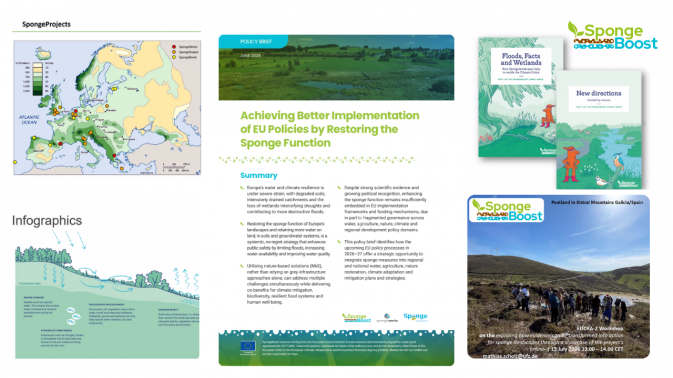
The webinar opened with an introduction to the SpongeBoost project and the importance of restoring sponge landscapes to improve water retention, increase resilience to floods and droughts, and support biodiversity. The project’s coordinator, Mathias Scholz, from the Helmholtz Centre for Environmental Research (UFZ), presented the project's objectives, monitoring sites across Europe, and ongoing work to evaluate restoration successes and lessons learned.
Jos De Bijl from Bureau Stroming introduced the S.P.O.N.G.E. database, a navigation guide that brings together data from across Europe and offers a geographical overview of projects and measures that improve the S.P.O.N.G.E. capacity of landscapes. The session demonstrated how users can explore projects, search by landscape type or restoration measure, access best practice resources, and contribute new projects to help expand the knowledge base.
Carina Darmstadt from Environmental Action Germany (DUH) presented SpongeBoost's comic book series, explaining how storytelling and visual communication help make complex concepts more accessible to wider audiences. Participants also learned about the development of the character Spongy, the project's comic book character, and the upcoming third comic book planned for spring 2027.
Finally, Claire McCamphill from Wetlands International Europe introduced the newly published policy brief Achieving Better Implementation of EU Policy by Restoring Sponge Function. The presentation highlighted opportunities to integrate sponge measures into key EU policies, including the Water Framework Directive, Floods Directive, Nature Restoration Regulation, Common Agricultural Policy, Drinking Water Directive and Soil Monitoring Law.
The webinar concluded by emphasising that sponge restoration is already supported by a growing body of evidence and practical experience. Participants were encouraged to explore and share the project's resources and to stay engaged through the project's newsletter and social media channels.